
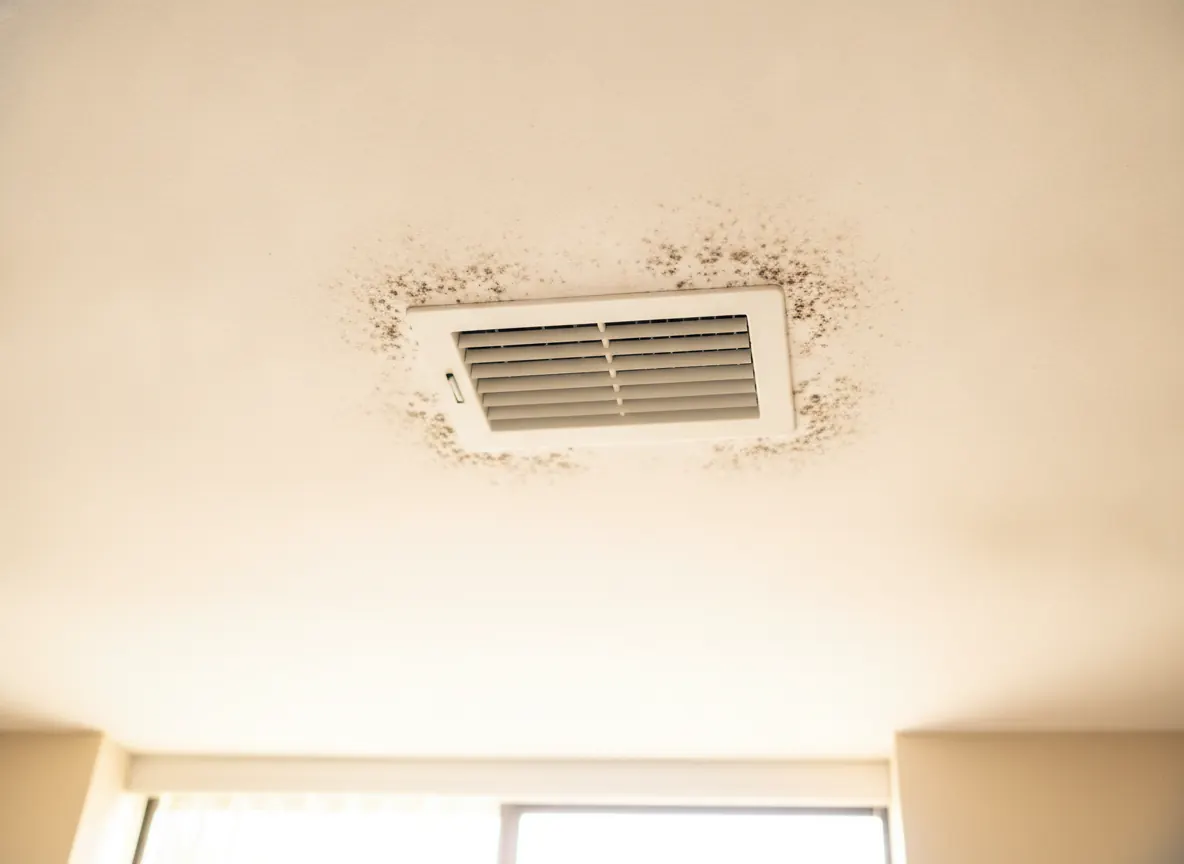
Dark specks around a ceiling vent are one of the most common things Central Florida homeowners notice once the rainy season settles in. Sometimes it's dust that has collected on a damp grille. Sometimes it's mold. And sometimes it's a sign of a moisture problem further back in the system. Here's what causes it, what the EPA says about cleaning it, and how Florida law decides who can work on it.
Why mold shows up around AC vents in Central Florida
Mold needs moisture, and Orlando has plenty. NOAA's 1991–2020 normals for Orlando International Airport show summer dew points averaging above 70°F from June through September, with a rainy season that typically runs from late May to mid-October. When cold supply air meets that humid indoor air at a vent, moisture can condense on the grille and the ceiling around it. The EPA notes that "condensation can be a sign of high humidity" and that "the presence of condensation or high relative humidity is an important indicator of the potential for mold growth" in ducts.
Common moisture sources in Florida homes include:
- High indoor humidity. The EPA recommends keeping indoor humidity "below 60 percent (ideally between 30 and 50 percent)." An oversized air conditioner can cause "poor moisture removal, particularly in areas with high humidity," according to the EPA.
- A clogged condensate drain or dirty drain pan. The EPA's advice is to "keep air conditioning drip pans clean and the drain lines unobstructed and flowing properly." See our AC condensate drain line page.
- Leaky or sweating attic ductwork. Studies by the Florida Solar Energy Center at UCF found significant duct leaks in a majority of the new central Florida homes it tested. Leaks can pull hot, humid attic air into the system. Our duct repair and sealing page covers this.
- Flooding or long power outages. Hurricane Ian dropped 13.2 inches of rain at Orlando International in 2022, according to the National Hurricane Center, and widespread outages left many homes without AC in humid weather.
Mold on the vent cover vs. mold inside the ducts
Spots on the outside of a grille or the ceiling around it are often a surface condensation problem. Growth that you can see inside the duct, on the air handler, on the coil or in the drain pan is a bigger deal, because the system can carry it through the house. The EPA's first reason to consider duct cleaning is when "there is substantial visible mold growth inside hard surface (e.g., sheet metal) ducts or on other components of your heating and cooling system."
Whether the growth looks black, green or gray, the steps below are the same. Don't rely on color to judge how serious it is, and don't rely on a salesperson's word alone. The EPA says to "ask the service provider to show you any mold they say exists."
Signs of mold in air ducts
- A musty odor when the AC kicks on. The EPA lists "musty odor or visible mold growth" as signs of contamination.
- Visible growth on supply grilles, inside the first few inches of a duct, or on the air handler cabinet.
- Water stains, dripping or sweating around vents or ceiling ducts.
- Standing water in the drain pan, or a drain line that keeps clogging.
If anyone in your home has symptoms you think might be related to mold, talk to a doctor. This article is about the equipment, not your health.
Will air duct cleaning remove mold?
Sometimes, but not always. The answer depends on what the duct is made of:
- Hard (sheet metal) ducts with visible growth are the case the EPA describes as worth considering for cleaning, once the moisture cause is found.
- Insulated ducts, flex duct and duct board are different. The EPA says, "If you have insulated air ducts and the insulation gets wet or moldy it cannot be effectively cleaned and should be removed and replaced." Many Florida homes use flex or duct-board ducts, so "mold in the ducts" often means replacing sections of duct rather than cleaning them.
Cleaning without fixing the cause won't last. The EPA warns, "If the conditions causing the mold growth in the first place are not corrected, mold growth will recur."
Be careful with sprays, foggers and coatings. According to the EPA, "No chemical biocides are currently registered by EPA for use in internally-insulated air duct systems," and research "has not demonstrated their effectiveness in duct cleaning or their potential adverse health effects." It also says sealants "should never be used on wet duct liner, to cover actively growing mold, or to cover debris in the ducts." If a product is offered anyway, the EPA says the provider should "show you the biocide label," and that applying a pesticide in a way that doesn't match its label violates federal law.
The 10 square foot rule in Florida mold law
Florida licenses mold remediation under Part XVI of Chapter 468 of the Florida Statutes. The definition in s. 468.8411(5) covers the "removal, cleaning, sanitizing, demolition, or other treatment, including preventive activities, of mold or mold-contaminated matter of greater than 10 square feet." Small areas of 10 square feet or less fall outside that definition.
The law also keeps mold work and AC work in separate lanes:
- A mold remediator can't open up your AC system on that license alone. Under s. 468.8411(6), "a mold remediator may not perform any work that requires a license under chapter 489 unless the mold remediator is also licensed under that chapter."
- An AC contractor working within its license may be exempt. Section 468.841(2)(d) exempts businesses "acting within the scope of" a Chapter 489 contractor license, except when they hold themselves out as a "mold remediator" or similar title. Whether duct-interior mold work falls "within the scope" is a reading of the law, not a court or board ruling.
- A duct cleaner with neither license shouldn't be treating mold in your ducts at all.
Who can legally fix mold in your AC in Florida?
In Florida, duct cleaning that involves removing grilles and AC coil work is licensed air-conditioning contractor work. Ask for the company's CAC/CMC license number and check it at MyFloridaLicense.com. A county business tax receipt is not a license. If a company says it's a mold remediator, the individual's mold remediator license can be checked on the same DBPR site. Be wary of anyone who promises to "remove all the mold" from ducts without explaining which license covers the work. This is general information, not legal advice. Our post on Florida duct cleaning licenses has the lookup steps.
Fix the moisture first
Find the water
Check the drain pan, the condensate line, attic duct joints and any sweating vents. A coil or air handler problem is a job for an AC contractor; see AC coil and air handler cleaning.
Get humidity under control
Aim for the EPA's below-60-percent target. If the house stays clammy with the AC running, ask whether the system is sized and set up properly.
Clean or replace the affected parts
Hard surfaces may be cleaned. Wet or moldy insulated duct should be removed and replaced, per the EPA.
Be careful after a flood
The Florida Department of Health warns: "If the system was flooded, turning it on without proper cleaning will spread mold throughout your home."
What mold-related HVAC work typically costs
These are typical ranges from EPA, NADCA, HomeAdvisor (2026) and Fixr (2026). They are estimates, not quotes.
| Item | Typical range |
|---|---|
| Whole-system duct cleaning (EPA and NADCA) | $450–$1,000 per system |
| HVAC mold remediation add-on | $1,000–$5,000; whole-system mold $3,000–$10,000 |
| Duct repair / sealing | repair $200–$800; sealing and repairs $500–$4,000 |
| Sanitizing (if not included) | $100–$250 |
Get written estimates that name the cause, the parts to be cleaned or replaced, and any product to be used. Our mold in AC vents and ducts page and the cost guide go further.
How Orlando Air Duct Pros works: We connect Orlando-area homeowners with independent local air duct and HVAC companies for free, no-obligation quotes. We don't do the work ourselves and aren't a contractor. To have a local company look at the mold around your vents and explain the options, request a free quote.