
You switch the system on, and a damp, basement-like smell drifts out of the vents. If your AC smells musty, you're in good company in Central Florida, where the air conditioner runs nearly every month of the year and the outdoor air is loaded with moisture for much of it. A musty odor is a clue about moisture somewhere in the system. This guide covers where that smell usually starts, what the EPA says to look for, simple checks you can make, and when to bring in a licensed AC contractor.
This article is about the equipment, not about health. A smell alone can't tell anyone what is in the air or how it might affect you. If anyone in your home has symptoms or health concerns, talk to a doctor.
Why Orlando homes are prone to musty AC smells
Air conditioners cool by pulling heat and moisture out of the air. That moisture condenses on the indoor coil, drips into a drain pan and leaves through the condensate drain line. In Orlando, the system does that job a lot:
- NOAA's 1991–2020 normals for Orlando International Airport show about 3,452 cooling degree days a year, versus about 525 heating degree days. Even January logs some cooling demand.
- The airport averages about 110 days a year with a high of 90°F or more.
- Summer dew points average above 70°F from June through September, and the rainy season runs from late May to mid-October.
More run time and more moisture means more water moving through the coil, pan and drain, and more chances for something to stay wet. The EPA notes that "the presence of condensation or high relative humidity is an important indicator of the potential for mold growth" in ducts.
Where a musty AC smell usually comes from
1. The drain pan and condensate drain line
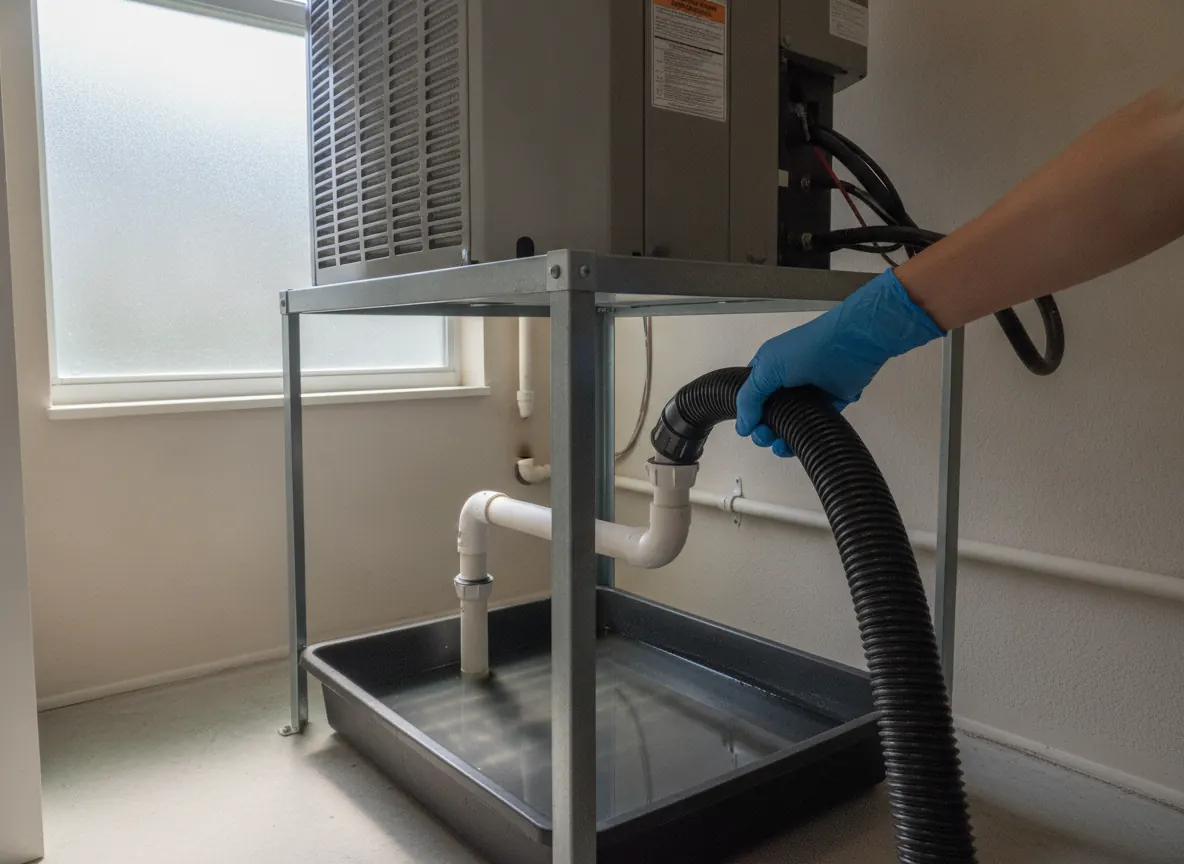
The drain pan under the coil is meant to empty constantly. If the condensate line slows or clogs, water sits in the pan, and standing water in a dark cabinet is a common source of a mildew-like smell. The EPA's mold guidance is direct on this: "Keep air conditioning drip pans clean and the drain lines unobstructed and flowing properly."
AC drain line clogged symptoms to watch for:
- Water standing in the drain pan or around the base of the air handler.
- Drips, stains or a damp spot on the ceiling or wall near an attic or closet air handler.
- Little or no water coming out where the drain line ends outside, on a day the AC has been running hard.
- The system shutting itself off, which on many setups means a float or overflow switch has tripped.
- A musty smell that is strongest near the air handler or the return grille.
Our AC condensate drain line page explains what clearing and preventing clogs typically involves.
2. The evaporator coil and blower
The indoor coil is wet whenever the AC runs. Dust that gets past the filter sticks to that wet surface, and over time the coil and the blower wheel can build up a film that holds moisture and odor. The EPA notes that "some research also suggests that cleaning dirty cooling coils, fans and heat exchangers can improve the efficiency" of a system. Coil and blower work means opening the air handler, which is licensed AC contractor work in Florida. See AC coil and air handler cleaning.
3. The ducts themselves
Many Central Florida homes have flex duct or fiberglass duct board running through hot attics. When cold, dry supply air travels through a duct surrounded by humid attic air, any gap, crushed section or damaged insulation can lead to condensation. Musty air ducts are the result some homeowners notice first.
Here the EPA draws a firm line: "If you have insulated air ducts and the insulation gets wet or moldy it cannot be effectively cleaned and should be removed and replaced." Palm Beach County Consumer Affairs adds that flex and fiber ducts "should not be cleaned aggressively," because doing so can loosen fiberglass. So a musty smell from insulated ducts can point toward repair or replacement rather than cleaning. Our duct repair and sealing page covers that side.
4. Humidity that stays too high
Sometimes the problem isn't one dirty part. It's that the house stays too humid. The EPA recommends keeping indoor humidity "below 60 percent (ideally between 30 and 50 percent)," and notes that "condensation can be a sign of high humidity." The EPA also says an oversized air conditioner can cause "poor moisture removal, particularly in areas with high humidity," because it cools the house quickly and shuts off before it has pulled much water out of the air.
Signs your home may be running humid: sweating windows or supply grilles, a clammy feel even when the thermostat is satisfied, or a reading above 60 percent on an inexpensive hygrometer.
5. Air leaking into the air handler
Air handlers in Florida often sit in garages, closets or attics. A 2002 study by the Florida Solar Energy Center of 30 new central Florida homes found that the average air-handler cabinet let in about 6 percent of system airflow from the garage or attic. Unconditioned, humid air pulled into the return side can carry attic or garage odors into the house.
Mildew in AC vents: what you can safely check yourself
Changing a filter and looking at a grille don't require a license. DBPR's handout lists "Change an A/C filter" as work that does not need one. Here's a homeowner-level checklist:
Replace the filter
A clogged or damp filter can hold odor. Check the size printed on the frame and swap it out. Our MERV filter guide explains how to choose one.
Look at the supply grilles
Dark spots or droplets on the grille face often mean condensation. Note which rooms and when.
Find the drain line outlet
On a hot afternoon with the AC running, check whether water is dripping out where the line ends outside.
Measure humidity
A hygrometer reading consistently above 60 percent is worth mentioning to an AC contractor.
Notice where the smell is strongest
Near the air handler, at one vent, or everywhere? That detail helps a contractor narrow it down.
Don't spray household cleaners, bleach or "duct deodorizers" into vents or the air handler. The EPA cautions that for biocides used in ducts, "research has not demonstrated their effectiveness in duct cleaning or their potential adverse health effects," and that "it is a violation of federal law to use a pesticide product in any manner inconsistent with the label directions."
When to call a licensed AC contractor
Call when the smell sticks around after a filter change, when there's water where it shouldn't be, or when you can see growth on grilles, the coil or inside the cabinet. In Florida, opening the air handler, cleaning the coil or drain pan, and duct cleaning that removes grilles are licensed air-conditioning contractor work. Ask for the company's CAC or CMC license number and check it at MyFloridaLicense.com. A county business tax receipt is not a license. Our Florida duct cleaning license guide shows how.
A few EPA-based questions to bring along:
- Can you show me where the moisture or growth is? The EPA advises asking a provider "to show you any mold they say exists."
- What's causing it? The EPA warns that "if the conditions causing the mold growth in the first place are not corrected, mold growth will recur."
- Is any duct insulation wet or moldy, and if so, does it need replacement rather than cleaning?
- Can I have the total cost and scope in writing before work starts?
If visible growth covers a large area, Florida's mold law (s. 468.8411) applies to mold remediation "of greater than 10 square feet." A licensed AC contractor working within its license scope is exempt under s. 468.841(2)(d), provided it doesn't hold itself out as a mold remediator. See mold in AC vents and ducts and our Florida mold guide for more.
Compare quotes from local companies
We connect Orlando-area homeowners with independent local air duct and HVAC companies for free, no-obligation quotes. We don't do the work ourselves and aren't a contractor. Tell us what you're smelling and seeing, and request a free quote. For typical price ranges, see the air duct cleaning cost guide.