
The dryer is one of the hardest-working appliances in an Orlando home, and one of the easiest to forget about. Lint that slips past the screen collects inside the vent pipe, and over time that buildup becomes both a performance problem and a fire hazard. This guide covers what national fire data says about dryer fires, the signs of a clogged dryer vent, what you can do yourself, and what to expect from dryer vent cleaning in Orlando.
What the fire data says
Two national sources track dryer fires, and they point to the same leading cause.
- U.S. Fire Administration (USFA): "An estimated 2,900 clothes dryer fires in residential buildings are reported" each year, and "failure to clean (34 percent) was the leading factor" contributing to those fires. (USFA report based on 2008–2010 data, published August 2012.)
- National Fire Protection Association (NFPA): an estimated 13,820 home structure fires per year involving dryers from 2014 to 2018, and "one-third (32 percent) of dryer fires were caused by a failure to clean." (NFPA, June 2020.)
The two figures measure slightly different things and come from different years, so don't add or compare them directly. The consistent takeaway is that roughly a third of dryer fires trace back to lint and debris that nobody cleaned out.
Why lint builds up in the first place
The lint screen catches most fibers, not all of them. The rest ride the hot, damp exhaust air through the vent pipe to the outside hood. Anything that slows that air down gives lint a chance to settle: long runs, extra bends, crushed or kinked transition hose behind the dryer, or a hood flap that sticks. Over months, a thin coating turns into a plug.
A few situations common in the Orlando area make a slow vent more likely:
- Long vent runs. Laundry rooms in the middle of a house, or upstairs, often vent through a wall or roof a long way from the dryer.
- Heavy use. Larger households, rentals with frequent turnover and vacation homes that do a lot of laundry between guests all push more lint through the line.
- Shared or hard-to-reach vents. In condos and apartments, the vent may run through spaces the resident can't see or reach.
Orlando is also a majority-renter city: the Census Bureau's American Community Survey (2020–2024) puts owner-occupied homes at about 39.5 percent of occupied units. If you rent, the vent behind the wall is usually your landlord's or association's responsibility, so let them know if you see the warning signs below.
Signs of a clogged dryer vent
- Loads take longer to dry than they used to, or need a second cycle.
- Clothes and the top of the dryer feel unusually hot at the end of a cycle.
- The laundry room gets warm and stuffy while the dryer runs.
- Lint collects around the outside vent hood, or the hood flap barely opens when the dryer is on.
- You feel weak airflow at the outside hood while the dryer is running.
- A burning or scorched smell when the dryer is on. If you notice this, stop using the dryer until it has been checked.
Any one of these is a reason to look closer. Several together usually mean the vent needs cleaning.
What you can do yourself
Clean the lint screen every load
It's the single easiest habit. A full screen sends more lint into the vent.
Check the transition hose
Pull the dryer out carefully and look at the hose between the dryer and the wall. It should be short, not crushed or kinked, and firmly connected at both ends.
Check the outside hood
With the dryer running, make sure the flap opens and air is blowing out. Clear any visible lint at the opening.
Don't run the dryer when you're away
Being home and awake when the dryer runs means you'll notice a problem sooner.
Brushing out a short, straight run is something many homeowners handle with a kit. Long runs, roof terminations, second-story vents and vents with several bends are usually a job for a professional with the right brushes and vacuum.
What professional dryer vent cleaning typically involves
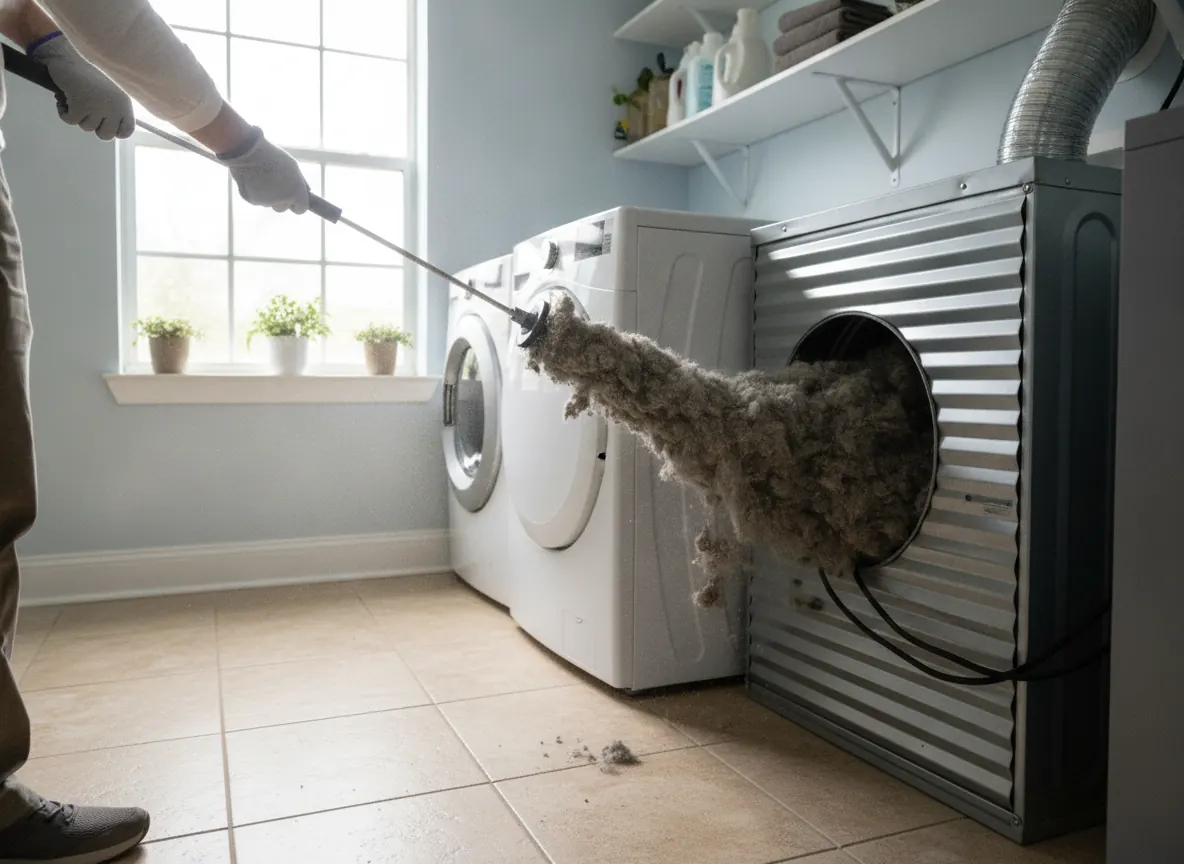
A typical visit includes disconnecting the dryer from the wall, running rotary brushes through the vent line, vacuuming out the loosened lint, clearing the exterior hood, and checking airflow once everything is reconnected. A good company will tell you if it finds a crushed hose, a disconnected joint or a vent that's longer or more convoluted than it should be.
See our dryer vent cleaning page for more detail on the process.
Does dryer vent cleaning require a Florida license?
Usually not, for straightforward cleaning. In Declaratory Statement 2014-125 (filed January 30, 2015), Florida's Construction Industry Licensing Board found that "because there is no disassembly of the dryer exhaust system in order to clean the dryer vent using the method described, a mechanical contractor's license is not necessary." That ruling applied to the specific method described by that petitioner. Rerouting, replacing or re-building a vent is different work. And air duct cleaning that removes grilles is licensed air-conditioning contractor work in Florida. Our Florida duct cleaning license guide explains the difference. This is general information, not legal advice.
What dryer vent cleaning costs
National cost guides put dryer vent cleaning at about $100–$170 on its own, or about $100 when added to an air duct cleaning. These are typical ranges from HomeAdvisor (2026) and Fixr (2026), estimates rather than quotes. Long runs, roof vents and repairs can change the price. See the full air duct cleaning cost guide for more ranges.
If a dryer vent cleaning is bundled into a "$99 whole house" duct cleaning special, read our $99 duct cleaning scam guide first. NADCA, the National Air Duct Cleaners Association, tells consumers to "avoid advertisements for '$99 whole house specials' and other sales gimmicks."
Questions to ask a dryer vent company
- How will you clean the vent, and from which end?
- Will you check airflow before and after?
- Is the exterior hood included? What about the roof, if the vent goes up?
- If you find damaged or crushed vent pipe, will you show me and give a separate written price before doing any repair?
- What is the total price, in writing, before you start?
Get free quotes in Orlando and nearby
We connect Orlando-area homeowners with independent local air duct and dryer vent companies for free, no-obligation quotes. We don't do the work ourselves and aren't a contractor. Quotes are available across Orlando and nearby cities like Kissimmee, Winter Park and Sanford. When you're ready, request a free quote.