
The flyer, text or social media ad promises your whole house's air ducts cleaned for $99. In Orlando, where the AC runs all year and plenty of homeowners worry about dust and mold, those offers find an audience. Most of them aren't what they seem. Here's how the "$99 air duct cleaning" pitch usually works, what national and Florida sources say about it, and a checklist to protect yourself before anyone touches your system.
What NADCA says about $99 whole-house specials
The National Air Duct Cleaners Association (NADCA) is the industry's trade group, and it warns consumers directly: "Avoid advertisements for '$99 whole house specials' and other sales gimmicks." It goes further: "Homeowners should be cautious of advertisements promoting extremely low-cost 'whole house' air duct cleaning specials. These offers often include only limited portions of the system and may exclude critical components such as the air handler, blower fans, coils, registers, or necessary access openings."
NADCA also describes the "blow-and-go" operator: "These companies often charge a nominal fee and do a poor job of cleaning the heating and cooling system. These companies may also persuade the consumer to pay for unneeded services with and/or without their permission."
How the bait-and-switch usually works
The hook
A price far below the going rate. EPA and NADCA both put typical whole-system cleaning at $450–$1,000, so $99 can't cover a real source-removal job on a whole system.
The quick look
A crew shows up, runs a vacuum at a few registers, and maybe shows you a photo or a dirty filter.
The scare
You're told there's mold, a health hazard or a "contaminated" air handler that isn't covered by the special.
The upsell
Sanitizers, fogging, coatings, "mold removal" or repairs get added, often under time pressure.
Officials and reporters elsewhere have described the same pattern. The Michigan Attorney General warned in 2023 that blow-and-go companies use "rock bottom prices to hook customers and then will add on unnecessary services, like costly repairs or mold removal." FOX 5 in Washington, D.C. reported on a "$99" ad where the bill "ballooned… to nearly $6,000." A Palm Beach County Consumer Affairs tip sheet uses an illustrative example of a "$100 limited time special" that turned into a bill of over $1,000.
Red flags the EPA tells homeowners to watch for
The EPA's guide Should You Have the Air Ducts in Your Home Cleaned? gives a short list of warning signs:
- Health promises. "Do not hire duct cleaners who make sweeping claims about the health benefits of duct cleaning — such claims are unsubstantiated." The EPA says duct cleaning "has never been shown to actually prevent health problems."
- "Routine" cleaning pitches. "Do not hire duct cleaners who recommend duct cleaning as a routine part of your heating and cooling system maintenance."
- "EPA-certified" claims. "Be wary of duct cleaners who claim to be certified by EPA." EPA does not certify duct cleaners. In the agency's words, it "neither establishes duct cleaning standards nor certifies, endorses, or approves duct cleaning companies."
- Mold you never see. The EPA says to "ask the service provider to show you any mold they say exists." A claim of mold you can't see is not a reason to pay for treatment on the spot.
Florida's extra layer: licensing
In Florida, duct cleaning that involves removing grilles and AC coil work is licensed air-conditioning contractor work. Ask for the company's CAC/CMC license number and check it at MyFloridaLicense.com. A county business tax receipt is not a license.
The rule comes from Florida Statutes s. 489.105(3), which includes "any duct cleaning and equipment sanitizing that requires at least a partial disassembling of the system" in the air-conditioning contractor scope. A DBPR handout gives "removal of air grills" as the example of work that needs a license. Florida law also says a contractor's license number must appear in its advertisements (s. 489.119(5)(b)). A "$99" flyer with no license number on it is worth a second look. Dryer vent cleaning that doesn't require disassembly is different: a 2015 Construction Industry Licensing Board declaratory statement found no mechanical license was needed for the petitioner's no-disassembly method. This is general information, not legal advice. For the full walkthrough, read Do You Need a License to Clean Air Ducts in Florida?
What a legitimate duct cleaning includes
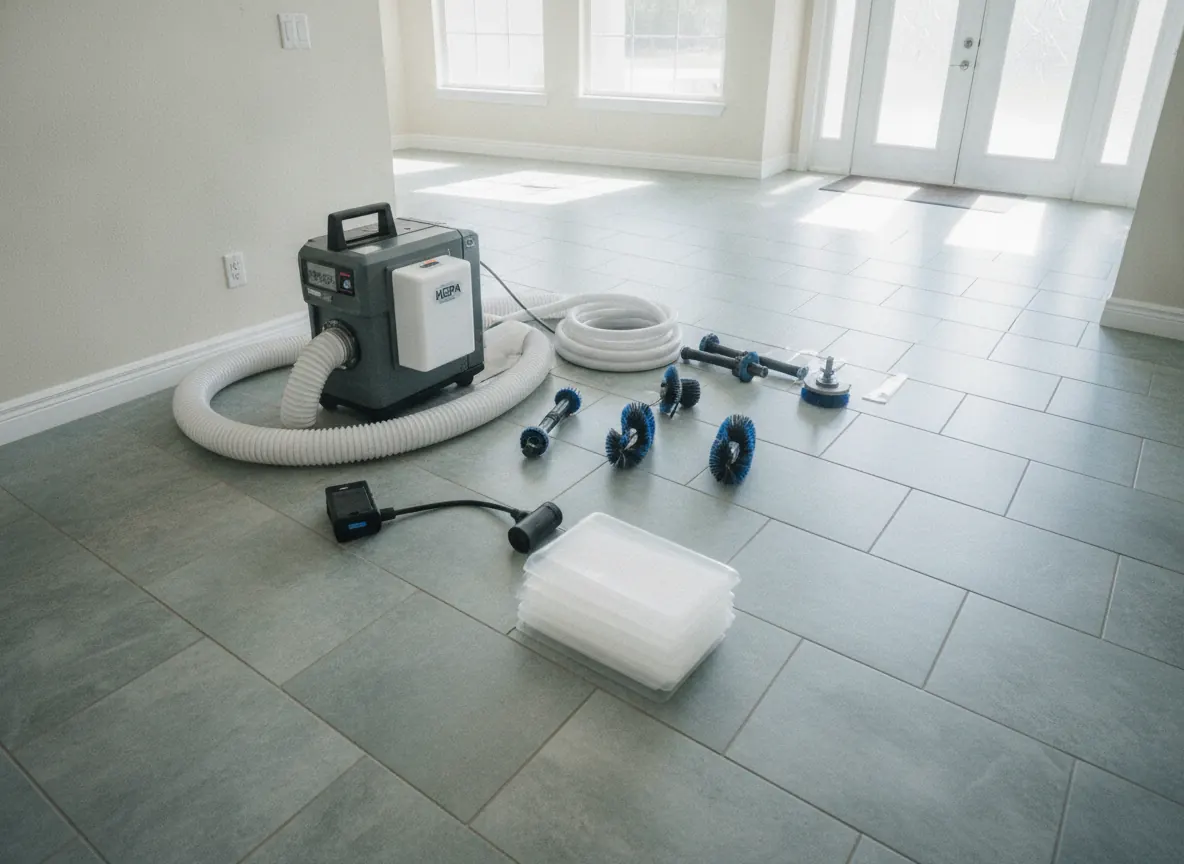
NADCA describes "source removal" as the effective method: the contractor places "the system under negative pressure, through the use of a specialized, powerful vacuum" while tools such as "brushes, air whips and 'skipper balls'" knock debris loose so it travels to the vacuum. NADCA adds that "a vacuum collection device alone will not get an HVAC system clean," and that "any vacuum collection device which exhausts indoors must be HEPA filtered."
The EPA's scope for duct cleaning covers much more than the vent grilles: "the supply and return air ducts and registers, grilles and diffusers, heat exchangers heating and cooling coils, condensate drain pans (drip pans), fan motor and fan housing, and the air handling unit housing." It also warns that "failure to clean a component of a contaminated system can result in re-contamination of the entire system." When the job is done, "all portions of the system should be visibly clean; you should not be able to detect any debris with the naked eye." Our process page explains what to expect step by step.
What real prices look like
These are typical ranges from EPA, NADCA, HomeAdvisor (2026) and Fixr (2026). They are estimates, not quotes.
| Item | Typical range |
|---|---|
| Whole-system duct cleaning (EPA and NADCA) | $450–$1,000 per system |
| Cost-guide averages | about $389 (HomeAdvisor) to $500 (Fixr) |
| Per vent | $25–$50 |
| By home size (Fixr) | 1,500 sq ft $225–$525 · 2,000 sq ft $300–$700 · 3,000 sq ft $450–$1,050 |
| Sanitizing (if not included) | $100–$250 |
A "$99 whole-house" offer falls well below every one of these ranges, which is exactly why NADCA flags it. Our air duct cleaning cost guide explains what drives a fair quote.
Your checklist before you agree to anything
- Get "written estimates" from "at least three different service providers," as the EPA suggests.
- Insist on "a written agreement outlining the total cost and scope of the job before work begins" (EPA).
- Ask exactly what's included: every supply and return, the air handler, the blower, the coil and the drain pan.
- Ask for the license number and look it up yourself before the visit.
- Ask the company to show you the contamination that justifies the work.
- If a sanitizer is offered, ask to see the label. The EPA notes that "no chemical biocides are currently registered by EPA for use in internally-insulated air duct systems."
- Don't sign or pay for add-ons under pressure. In the EPA's words, "they are trying to sell you a service, so ask questions and insist on complete and knowledgeable answers."
Not sure you need a cleaning at all? Start with Is Air Duct Cleaning Worth It in Florida? If a crew claims they found mold, read Mold in AC Vents in Florida before you agree to anything.
How Orlando Air Duct Pros works: We connect Orlando-area homeowners with independent local air duct and HVAC companies for free, no-obligation quotes. We don't do the work ourselves and aren't a contractor. Use your quotes to compare scope and price in writing. Request a free quote and we usually reply the same day.