
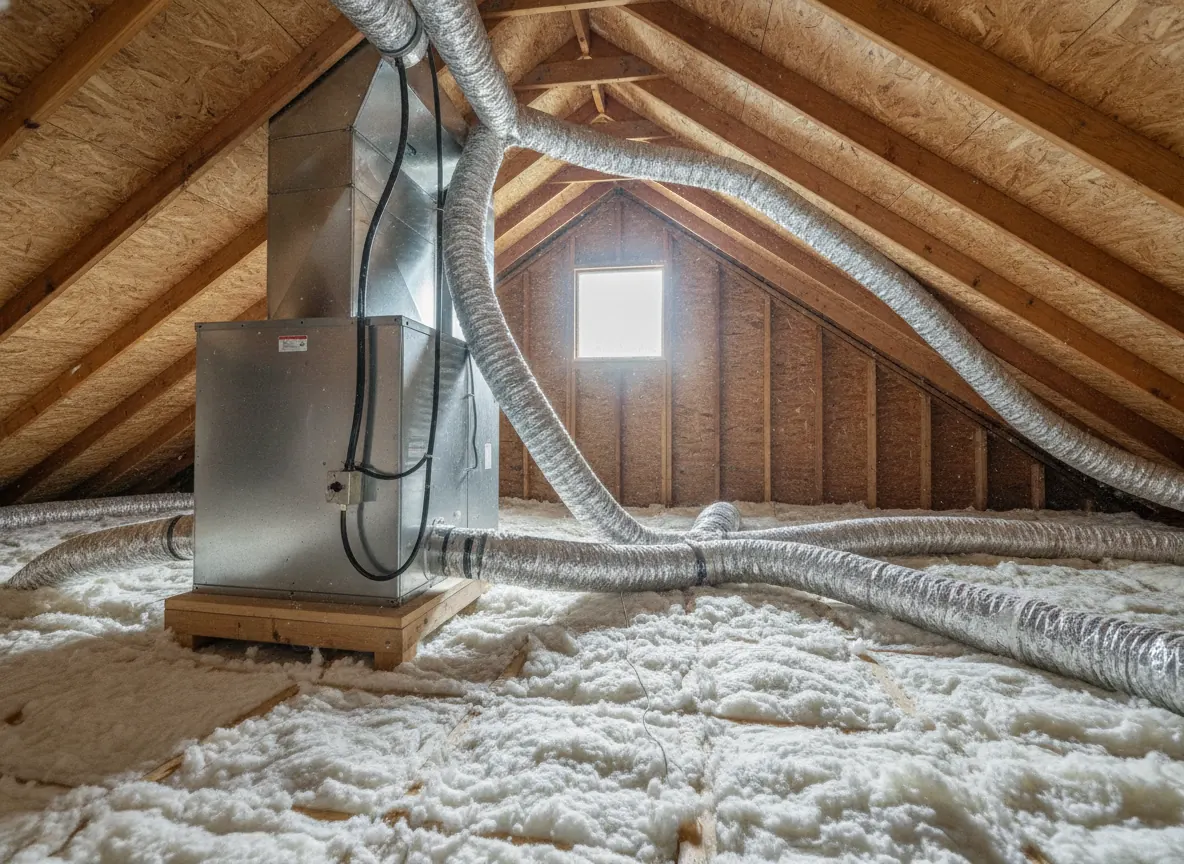
Search "how often should air ducts be cleaned in Florida" and you'll find confident answers: every two years, every three to five years, every year in a humid climate. Most of them don't cite anything. The sources that matter, the EPA and the National Air Duct Cleaners Association (NADCA), don't set a fixed schedule at all. Here's what they actually say, how Central Florida's climate fits in, and what an Orlando homeowner can do every year instead.
The short answer: when there's a reason, not on a calendar
The EPA "does not recommend that air ducts be cleaned except on an as-needed basis because of the continuing uncertainty about the benefits of duct cleaning under most circumstances." It goes further and tells homeowners not to hire duct cleaners "who recommend duct cleaning as a routine part of your heating and cooling system maintenance."
NADCA's current consumer FAQ also gives no set interval: "Frequency of cleaning depends on several factors, not the least of which is the preference of the homeowner."
The "every 3 to 5 years" myth
You'll often see the line "NADCA recommends cleaning every 3 to 5 years" on company websites and in cost articles. We looked for it on NADCA's own sites, nadca.com and BreathingClean.com, and didn't find it. Their consumer FAQ talks about factors, not a fixed number of years. A schedule you can't trace back to a source is a sales line, not a standard. If a company quotes a set interval to you, ask where it comes from.
Reasons to clean sooner, according to NADCA
NADCA lists situations that can call for more frequent cleaning:
- "smokers in the household"
- "pets that shed high amounts of hair and dander"
- "water contamination or damage to the home or HVAC system"
- residents with allergies or asthma (talk to a doctor about health questions; the EPA says duct cleaning "has never been shown to actually prevent health problems")
- "after home renovations or remodeling"
- "prior to occupancy of a new home"
The EPA's three triggers are narrower: "substantial visible mold growth inside hard surface (e.g., sheet metal) ducts or on other components" of the system, ducts "infested with vermin," or ducts "clogged with excessive amounts of dust and debris and/or particles are actually released into the home from your supply registers."
Does Central Florida's climate mean more frequent cleaning?
Not automatically, but it changes what to watch. NOAA's 1991–2020 normals for Orlando International Airport show about 3,452 cooling degree days a year versus about 525 heating degree days. July and August each log more than 540 cooling degree days, and even January logs about 45. Orlando averages about 110 days a year at 90°F or above, and summer dew points average above 70°F from June through September.
All that runtime and moisture point to two things worth checking more often than the ducts themselves:
- Moisture. The EPA says "the presence of condensation or high relative humidity is an important indicator of the potential for mold growth" in ducts, and recommends keeping indoor humidity "below 60 percent (ideally between 30 and 50 percent)."
- The parts that handle water. The EPA advises: "Keep air conditioning drip pans clean and the drain lines unobstructed and flowing properly." In a system that cools every month, the drain pan and condensate drain line see constant use.
Pollen season is real here too. UF/IFAS says Florida pollen "peaks from January to June," and News 13 calls live oak "one of the most dominant species in the region." Heavy pollen is a good reason to keep up with filter changes. It isn't, on its own, a reason to clean ducts on a schedule.
Events that are worth a closer look
| What happened | Why it matters |
|---|---|
| Flooding or water in the system | The Florida Department of Health warns: "If the system was flooded, turning it on without proper cleaning will spread mold throughout your home." |
| Long outage in humid weather | After Hurricane Ian in 2022, Fox Weather reported more than 200,000 Orange County households without power. Watch for musty odors or condensation once the AC comes back on. |
| Remodel or drywall work | NADCA lists renovation as a reason to clean, and recommends systems undergoing renovation be "verified clean and protected" before they run. |
| Moving into a home | NADCA lists "prior to occupancy of a new home." You don't know the previous owner's habits. |
| Pests in the ducts | One of the EPA's three triggers. |
| Wet or moldy flex or duct board | The EPA says insulated duct that gets wet or moldy "cannot be effectively cleaned and should be removed and replaced." See duct repair and sealing. |
What to check every year instead
Filters
Change them on the schedule your system's manufacturer gives, and more often in heavy pollen or with shedding pets.
Drain pan and drain line
Look for standing water, slime or a slow drain. A clog can overflow onto the ceiling.
Coil and blower
The EPA says research suggests "cleaning dirty cooling coils, fans and heat exchangers can improve the efficiency" of a system, while "little evidence exists" that duct cleaning alone does. See AC coil and air handler cleaning.
Supply registers
Shine a flashlight through a supply vent. Note visible growth, heavy debris or dust blowing out. The EPA says "it is normal for the return registers to get dusty."
Indoor humidity
A simple hygrometer tells you whether you're staying under the EPA's 60 percent mark.
When it's time, what does it cost?
These are typical ranges from EPA, NADCA, HomeAdvisor (2026) and Fixr (2026). They are estimates, not quotes.
| Item | Typical range |
|---|---|
| Whole-system duct cleaning (EPA and NADCA) | $450–$1,000 per system |
| Cost-guide averages | about $389 (HomeAdvisor) to $500 (Fixr) |
| AC cleaning / tune-up | $75–$200 |
| Dryer vent cleaning | $100–$170 alone; about $100 added to a duct cleaning |
More detail is in the air duct cleaning cost guide. Be careful with rock-bottom offers. NADCA warns consumers to "avoid advertisements for '$99 whole house specials'" (see The $99 Duct Cleaning Scam).
Check the license before the work starts
In Florida, duct cleaning that involves removing grilles and AC coil work is licensed air-conditioning contractor work. Ask for the company's CAC/CMC license number and check it at MyFloridaLicense.com. A county business tax receipt is not a license. This is general information, not legal advice; our Florida duct cleaning license guide explains the rule.
Still deciding? Is Air Duct Cleaning Worth It in Florida? covers the EPA's full position, and our air duct cleaning page explains what a thorough job involves.
How Orlando Air Duct Pros works: We connect Orlando-area homeowners with independent local air duct and HVAC companies for free, no-obligation quotes. We don't do the work ourselves and aren't a contractor. If one of the triggers above sounds familiar, request a free quote and compare what local companies recommend.